问题
随机划分和预计算图特征可能高估比特币反洗钱模型对未来交易的实际表现。
研究论文 · 图学习 · 金融取证
Exploring Topological Resilience: A Decoupled Dual-Pathway Graph Neural Network for Bitcoin Anti-Money Laundering under Concept Drift
TELEPE 2026 · 德国法兰克福 · 2026 年 6 月 24–26 日
随机划分和预计算图特征可能高估比特币反洗钱模型对未来交易的实际表现。
TSG-Net 将 GATv2 拓扑学习与保留原始交易信号的属性锚定路径分离。
在论文的严格时间协议下,TSG-Net 报告了较高的非法类精确率,并在 F1 上与随机森林持平。
近年来,图神经网络已开始应用于比特币反洗钱检测,但既有研究往往显著高估其实际表现。许多工作采用随机数据划分并依赖预先计算的全局统计特征,难以反映概念漂移下的真实取证环境。为此,本文提出拓扑同步图网络 TSG-Net,采用解耦的双路径结构:一条路径使用多头图注意力识别动态的拓扑异常,另一条路径通过残差模块保留交易节点的原始属性。结果表明,在后续时间步的交易模式持续变化时,传统静态模型的效果明显下降,而 TSG-Net 表现出更好的时间韧性。在 F1 保持在 0.75 以上的同时,非法节点精确率提高至 96%。隐藏层流形可视化进一步用于分析端到端图表示学习在复杂金融混淆问题中的作用。
In recent years, Graph Neural Networks have shown some applications in the area of Bitcoin Anti-Money Laundering Detection. However, the actual performance of Graph Neural Networks (GNNs) in applications has often been significantly overestimated in previous research. Most existing studies use random segmentations of the data and pre-calculated global statistical features, causing concept drift. In order to facilitate effective detection in real-world forensic scenarios, this paper proposes a Topological Synchronization Graph Network (TSG-Net). A disentangled two-path architecture has been used. On one hand, it uses a multi-head graph-attention module to identify dynamic Topology-Aware Anomalies. On the other hand, it maintains the original attribute characteristics of the transaction node using a residual module. The findings indicate that when confronted with evolving transactions in subsequent time steps, the efficacy of conventional static models is significantly diminished, while TSG-Net exhibits superior temporal resilience. It was demonstrated that, while maintaining an F1 score above 0.75, the model increased the precision for illegal nodes to 96%. Based on the visualization of the hidden-layer manifold, this paper also verifies that end-to-end graph representation learning is effective for resolving complex financial obfuscation problems.
研究将交易建模为节点,将资金流建模为有向边。实验移除 72 个预计算邻域聚合特征,仅保留前 94 个本地交易特征,并在时间上严格分离训练、模型选择与测试,以降低时间泄漏。
模型使用结构路径学习交易邻域模式,同时用属性路径保留可能被消息传递冲淡的本地信号。
多头 GATv2 从有向交易图中学习与风险相关的结构模式。
线性残差投影使 94 个本地交易特征能够直接参与最终判断。
两类表示在分类前拼接,并仅使用验证集选择决策阈值。
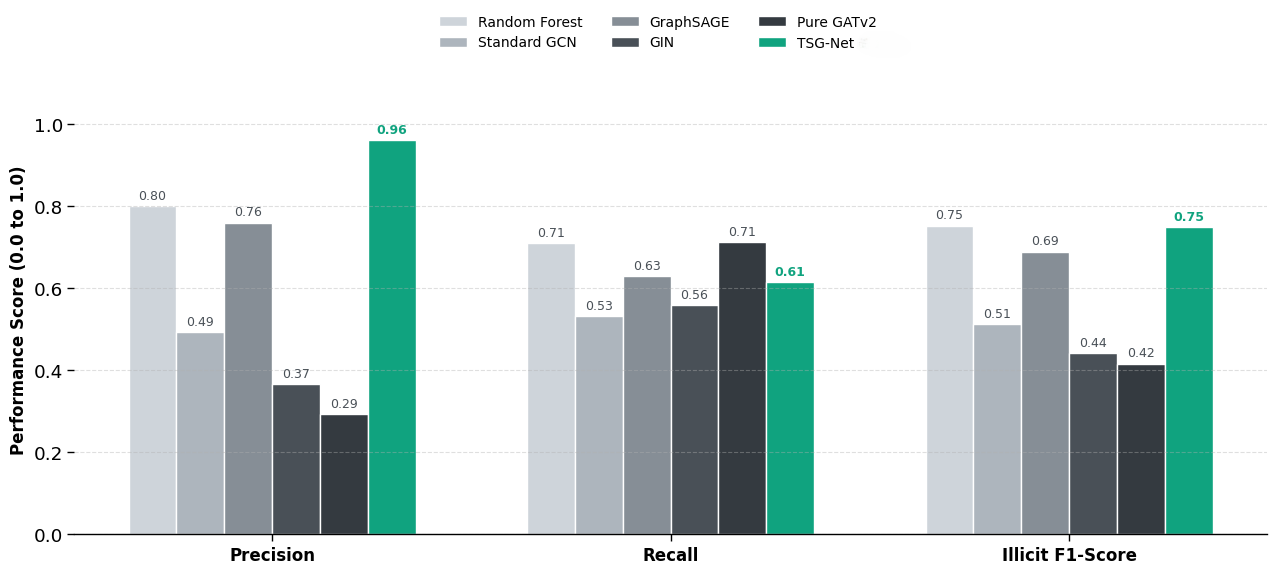
下图来自录用作者稿。TSG-Net 的非法类精确率为 0.96、F1 为 0.75;随机森林的 F1 同样为 0.75,但精确率较低、召回率较高。这体现的是工作点取舍,而不是对所有基线的全面领先。
前向时间分析显示,测试后段不同时间切片中的非法标签数量变化显著。当某个切片只有极少或没有非法样本时,逐时间步 F1 会变得不稳定或无定义。因此,我把尾部分析视为评估边界,而不是模型在每个未来时间步都持续有效的证据。
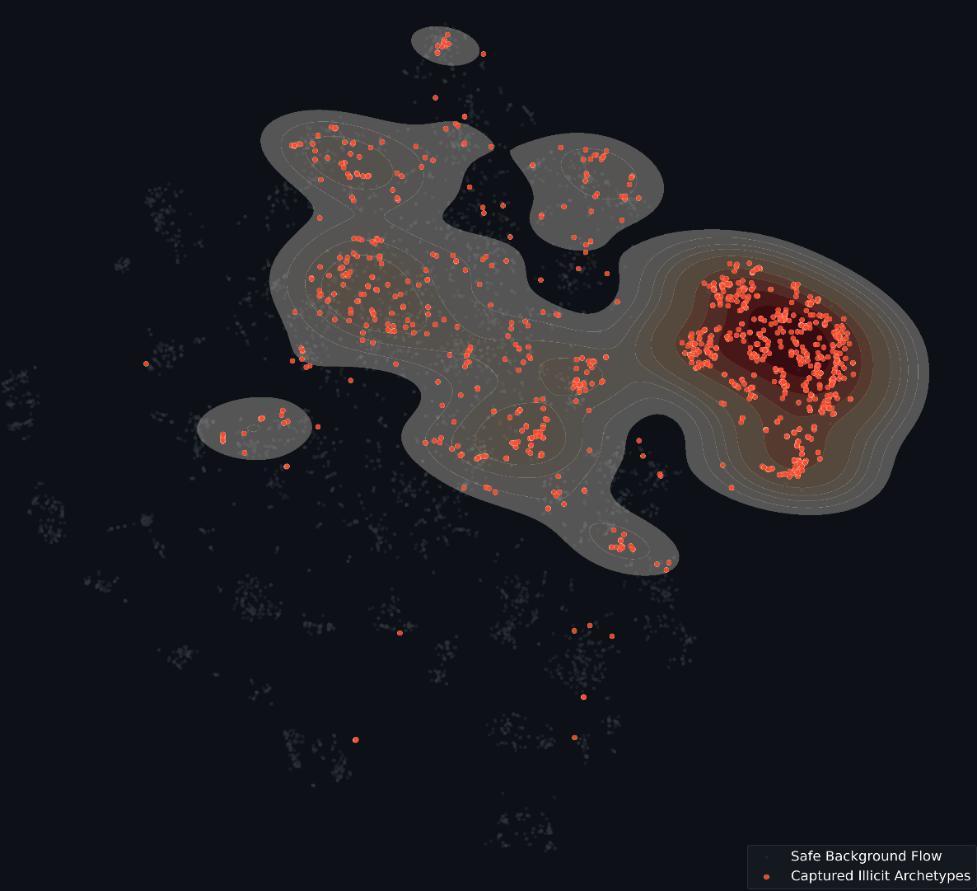
红点表示融合表示二维投影中的非法标签交易。图中出现局部聚集,但不能单独证明类别可分;论文报告的轮廓系数从 −0.1467 提高至 +0.0255。